
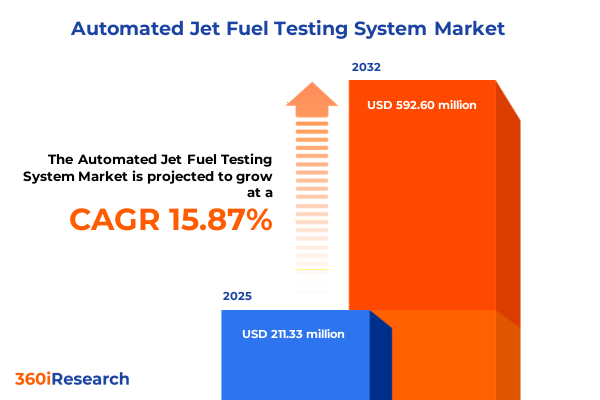
The Automated Jet Fuel Testing System Market size was estimated at USD 211.33 million in 2025 and expected to reach USD 241.46 million in 2026, at a CAGR of 15.87% to reach USD 592.60 million by 2032.
Understanding the Critical Role of Automated Jet Fuel Testing Systems in Ensuring Aviation Safety Compliance and Operational Efficiency Across Global Supply Chains
Automated jet fuel testing systems have swiftly become indispensable in safeguarding every phase of aviation operations, ensuring that the fuel powering global air travel adheres to the most exacting safety and quality benchmarks. Historically, manual sampling and laboratory analysis introduced delays and variability that could compromise both operational efficiency and passenger safety. The advent of automated solutions bridged this gap by enabling rapid, standardized testing at refineries, airports, and laboratory environments, significantly reducing turnaround times while elevating consistency and reliability.
As aviation regulators worldwide continue to tighten compliance standards and airlines expand their fleets, the demand for on-demand, precision-driven testing platforms has surged. Modern systems integrate advanced analyzers, high-precision sensors, and robust automation protocols to deliver real-time data, empowering maintenance teams and quality engineers to preemptively address anomalies. Moreover, streamlined reporting and seamless connectivity to enterprise resource planning and asset management systems have transformed fuel testing from an isolated procedural step into a continuous, intelligence-driven component of operational workflows.
This executive summary distills the essential trends, structural dynamics, and strategic imperatives shaping the automated jet fuel testing landscape. Subsequent sections explore technological innovations, the downstream effects of recent tariff policies, segmentation nuances across components and applications, regional variances, competitive positioning, and actionable recommendations for decision-makers seeking to harness these systems’ full potential.
Exploring Transformative Technological and Regulatory Shifts Shaping the Modern Automated Jet Fuel Testing Landscape for Resilient Operations
The automated jet fuel testing market is undergoing a period of rapid transformation fuelled by technological breakthroughs and shifting regulatory imperatives. Innovations in miniaturized chromatography and spectroscopy analyzers, coupled with the deployment of high-fidelity flow, pressure, and temperature sensors, have elevated the accuracy and responsiveness of testing platforms. Machine learning algorithms now enable predictive anomaly detection, signaling potential fuel contamination issues before they escalate into operational disruptions.
Parallel to these technical advances, aviation authorities and environmental regulators have introduced more stringent quality and emissions standards. The harmonization of test protocols across jurisdictions-from ASTM D1655 in the United States to international Civil Aviation Organization benchmarks-has driven demand for systems capable of multi-parameter, multi-region compliance. Reporting automation, featuring pre-configured regulatory templates, has further reduced the administrative burden on fuel quality teams while ensuring timely submission of required certifications.
Sustainability objectives and digital transformation initiatives are reinforcing one another, as organizations seek to optimize jet fuel performance and reduce carbon footprints. Automated testing solutions are increasingly integrated into broader operations intelligence platforms, enabling stakeholders to correlate fuel quality metrics with engine efficiency, maintenance schedules, and lifecycle emissions profiles. These converging drivers are reshaping the market landscape, raising the bar for system capabilities and underscoring the strategic value of real-time, data-centric quality assurance.
Analyzing the Cumulative Impact of Recent United States Tariffs on Automated Jet Fuel Testing Technology Adoption and Supply Chain Cost Structures
Recent United States tariffs on imported instrumentation and electronic components have exerted a measurable influence on the automated jet fuel testing ecosystem. By elevating the cost of critical hardware modules-such as chromatography analyzers, sensor arrays, and automation controllers-these policies have prompted system integrators and end users to revisit procurement strategies. Some providers have responded by shifting production to domestic facilities or renegotiating supplier agreements to mitigate input cost pressures.
The tariff-induced adjustments have reverberated through global supply chains, impacting lead times for hardware upgrades and maintenance spares. In certain cases, organizations have experienced delays in installation schedules and extended equipment downtime, as components sourced from tariff-affected regions require alternative sourcing routes. Consequently, maintenance teams are proactively scheduling preventive servicing and stocking critical spares to sustain uninterrupted operations.
Nevertheless, these challenges have spurred a broader industry response. Equipment manufacturers and solution providers have intensified their focus on modular architectures that allow for incremental upgrades and localized assembly. Additionally, a growing emphasis on software-driven enhancements and remote diagnostic capabilities has enabled firms to offset some of the cost impacts associated with hardware adjustments, ensuring continued investment in advanced testing technologies.
Unveiling Key Segmentation Insights to Illuminate the Diverse Components, Connectivity Modes, End Users, Deployment Approaches, and Applications Driving System Adoption
The automated jet fuel testing domain is defined by its multifaceted architecture, beginning with the hardware backbone that encompasses analyzers, automations, and sensor networks. Within analyzers, chromatography and spectroscopy platforms deliver complementary insights into fuel composition and contaminant profiles, while automation modules streamline sampling and reporting processes. Sensor networks, spanning flow, pressure, and temperature measurement, provide the foundational data streams that feed advanced analytics.
Complementing these hardware offerings, a range of professional services ensures optimal system deployment and ongoing performance. Regulatory and technical consultation guide organizations through evolving compliance landscapes, while preventive and corrective maintenance safeguard uptime. Training programs-delivered both online and onsite-facilitate user proficiency, enabling operational teams to extract maximum value from their testing investments.
Underpinning the hardware and services is a suite of software solutions, including descriptive and predictive analytics tools, data management platforms with robust security and storage capabilities, and integration frameworks supporting both API and system-level interoperability. This layered segmentation ensures that decision-makers can align their investments with organizational priorities-whether that be rapid, on-site quality monitoring, in-depth research and development for additive impact analysis, or stringent regulatory reporting requirements.
Connectivity further nuances system configurations, with wired installations providing reliable, low-latency data transfer, while wireless options-such as Bluetooth, cellular, and Wi-Fi-enable flexible deployment across terminal, refinery, and laboratory environments. Deployment modes span on-premise infrastructures as well as cloud-based environments, including hybrid, public, and private cloud configurations, offering scalable, secure access to testing data. Each of these segmentation dimensions combines to shape the adoption pathways and value propositions for automated jet fuel testing solutions.
This comprehensive research report categorizes the Automated Jet Fuel Testing System market into clearly defined segments, providing a detailed analysis of emerging trends and precise revenue forecasts to support strategic decision-making.
- Component
- Connectivity Type
- End User
- Deployment Mode
- Application
Revealing Critical Regional Insights into the Americas, Europe Middle East & Africa, and Asia-Pacific Markets Driving Automated Jet Fuel Testing Technology Development
In the Americas, robust aviation networks and extensive refining infrastructure have driven substantial investment in automated fuel testing. North American airlines and petroleum companies prioritize real-time quality assurance to support high-cycle aircraft operations, while South American refineries leverage advanced systems to enhance product consistency and align with emerging environmental requirements.
Across Europe, the Middle East, and Africa, regional dynamics vary considerably. European nations, driven by stringent EU fuel standards and decarbonization targets, have adopted automation to enhance compliance and reduce reporting burdens. In the Middle East, the expansion of refining capacities and ambitious national aviation initiatives have stimulated demand for high-throughput testing platforms, whereas in Africa, pilot projects and partnerships with international laboratories are laying the groundwork for broader adoption.
Asia-Pacific markets are marked by rapid fleet growth and refinery modernization programs. Major airlines in China and India are integrating automated testing into ground operations to minimize turnaround times, while research institutions in Japan and South Korea focus on additive impact analysis to support next-generation bio-jet fuels. In Southeast Asia and Australasia, hybrid cloud deployments are emerging as a preferred model, combining centralized data aggregation with on-site analytics to manage geographically dispersed operations.
This comprehensive research report examines key regions that drive the evolution of the Automated Jet Fuel Testing System market, offering deep insights into regional trends, growth factors, and industry developments that are influencing market performance.
- Americas
- Europe, Middle East & Africa
- Asia-Pacific
Mapping Competitive Dynamics and Strategic Positioning of Leading Players in the Automated Jet Fuel Testing System Industry for Market Dominance
The competitive landscape of the automated jet fuel testing industry is populated by established industrial automation leaders and specialized instrumentation firms. Global technology providers have deep expertise in analyzer hardware, sensor fabrication, and automation frameworks, with a focus on delivering turnkey solutions that integrate seamlessly into complex operational environments. These incumbents often leverage extensive service networks to provide regulatory consultation and field maintenance across multiple geographies.
Software vendors have become increasingly prominent, offering analytics platforms that transform raw sensor data into actionable insights. Emphasis on predictive maintenance and cloud-based monitoring services has driven strategic alliances between hardware manufacturers and software innovators, creating end-to-end offerings that address both testing accuracy and data intelligence requirements.
In parallel, a growing cohort of niche players is carving out market share by delivering highly specialized modules-such as rapid-cycle chromatography analyzers for additive impact research or portable spectroscopy units for field testing. These agile firms capitalize on modular designs and configurable software interfaces to address specific use cases, presenting a competitive counterpoint to broader platforms.
Mergers, acquisitions, and strategic partnerships continue to shape the industry, enabling players to expand their portfolios and geographic reach. Collaboration with regulatory agencies and research institutions further differentiates market participants, underscoring the importance of compliance expertise and innovation roadmaps in maintaining competitive advantage.
This comprehensive research report delivers an in-depth overview of the principal market players in the Automated Jet Fuel Testing System market, evaluating their market share, strategic initiatives, and competitive positioning to illuminate the factors shaping the competitive landscape.
- ALS Limited
- AMETEK, Inc.
- Ayalytical Instruments Inc.
- Bureau Veritas SA
- Cerlic Controls Ltd.
- Herzog Automation Corp.
- Horiba, Ltd.
- IROX AB
- Koehler Instrument Company, Inc.
- LabTech
- LabVantage Solutions, Inc.
- Optimus Instruments
- PAC L.P.
- Paragon Laboratories
- PetroSpec Ltd.
- SCION Instruments
- SGS SA
- Shimadzu Corporation
- Spectro Scientific (Ametek)
- Stanhope-Seta
- Tanaka Scientific Limited
Providing Actionable Recommendations for Industry Leaders to Navigate Market Complexities and Drive Innovation in Automated Jet Fuel Testing Solutions
Industry leaders should prioritize the development of modular, scalable testing architectures that accommodate evolving sensor technologies and analytic capabilities. By designing systems with plug-and-play hardware modules and flexible software frameworks, providers can future-proof their offerings and reduce upgrade cycles for end users.
To mitigate exposure to geopolitical and tariff-related cost fluctuations, organizations are advised to establish diversified supply chains and local assembly hubs. Strategic partnerships with regional manufacturers can secure critical component access and enhance responsiveness to on-site service needs, while joint development agreements with semiconductor and sensor specialists may yield proprietary advantages.
Embracing cloud-native platforms equipped with robust cybersecurity protocols will be essential for supporting remote monitoring, data sharing, and collaboration across distributed operational sites. By leveraging hybrid cloud deployments, firms can strike an optimal balance between data sovereignty, latency requirements, and cost efficiency.
Collaboration with regulatory bodies and research laboratories can accelerate the validation of new fuel formulations and additive impact methodologies. Industry consortia and standards committees offer venues for shaping test protocols, ensuring that system capabilities align with emerging compliance thresholds and environmental guidelines.
Finally, integrating sustainability metrics into testing workflows-such as correlating contaminant profiles with emissions modeling-can position organizations at the forefront of decarbonization efforts. By providing insights on fuel efficiency and lifecycle emissions, automated testing systems can become central to corporate sustainability agendas.
Detailing the Robust Research Methodology Employed to Deliver Comprehensive Insights into the Automated Jet Fuel Testing Systems Market
This research is grounded in a comprehensive methodology that combines extensive secondary research with targeted primary engagement. Industry white papers, regulatory filings, technical journals, and patent databases provided foundational insights into technological capabilities, compliance frameworks, and competitive activity.
Primary data collection involved in-depth interviews with key stakeholders, including fuel quality managers at leading airlines, laboratory directors at both government and private testing facilities, operations executives at refinery complexes, and solution architects at system integrators. These conversations elucidated real-world challenges, investment priorities, and performance expectations for automated testing platforms.
Data triangulation and cross-validation techniques were applied to reconcile disparate information sources, ensuring that findings reflect both macro-level trends and micro-level operational nuances. A proprietary framework segmented the market across components, connectivity, end users, deployment modes, and applications, enabling a multi-dimensional analysis of adoption drivers and value propositions.
Quantitative and qualitative insights were synthesized to produce a balanced perspective, with ongoing expert reviews affirming the integrity and relevance of the conclusions. This structured approach ensures that the report delivers rigorous, actionable intelligence tailored to the strategic needs of aviation, energy, and laboratory stakeholders.
This section provides a structured overview of the report, outlining key chapters and topics covered for easy reference in our Automated Jet Fuel Testing System market comprehensive research report.
- Preface
- Research Methodology
- Executive Summary
- Market Overview
- Market Insights
- Cumulative Impact of United States Tariffs 2025
- Cumulative Impact of Artificial Intelligence 2025
- Automated Jet Fuel Testing System Market, by Component
- Automated Jet Fuel Testing System Market, by Connectivity Type
- Automated Jet Fuel Testing System Market, by End User
- Automated Jet Fuel Testing System Market, by Deployment Mode
- Automated Jet Fuel Testing System Market, by Application
- Automated Jet Fuel Testing System Market, by Region
- Automated Jet Fuel Testing System Market, by Group
- Automated Jet Fuel Testing System Market, by Country
- United States Automated Jet Fuel Testing System Market
- China Automated Jet Fuel Testing System Market
- Competitive Landscape
- List of Figures [Total: 17]
- List of Tables [Total: 3339 ]
Summarizing Key Findings and Strategic Considerations to Foster Insightful Decision Making in Automated Jet Fuel Testing System Investments
Automated jet fuel testing systems are now central to achieving higher safety standards, operational efficiency, and environmental compliance across the aviation value chain. Technological advancements in analyzers, sensors, and analytics software have unlocked real-time visibility into fuel quality, while tariff-driven supply chain shifts have prompted resilient sourcing and modular design strategies.
Segmented analysis highlights the nuanced requirements of hardware, services, software, connectivity, deployment models, and application areas, all of which contribute to the bespoke solutions required by airlines, refineries, and test laboratories. Regional dynamics underscore the diverse market trajectories in the Americas, EMEA, and Asia-Pacific, and the competitive ecosystem is evolving rapidly through strategic alliances and innovation.
For decision-makers, aligning investments with these strategic insights will be critical to sustaining compliance and performance imperatives. As automation and data intelligence continue to converge, the systems that can deliver precise, actionable fuel quality data will stand at the forefront of industry leadership.
Engage with Ketan Rohom to Access the Full Automated Jet Fuel Testing Systems Market Research Report and Uncover Strategic Growth Opportunities Today
To access the comprehensive market research report and unlock the full spectrum of strategic insights, we invite you to engage directly with Ketan Rohom, Associate Director, Sales & Marketing. Ketan’s deep understanding of industry dynamics and proven track record in guiding aviation and energy stakeholders will ensure you receive tailored guidance on leveraging the latest advancements in automated jet fuel testing systems. By reaching out, you will gain personalized support on how to integrate our findings into your strategic planning and operational roadmaps
Contacting Ketan today opens the door to a detailed discussion of report highlights, exclusive executive briefings, and bespoke consultancy services. Don’t miss the opportunity to translate data into decisive action, strengthen your competitive position, and optimize your testing operations for enhanced safety, compliance, and efficiency. Your next steps toward transformational growth begin with a single conversation-connect with Ketan Rohom now and start capitalizing on the strategic advantages outlined in this research report

- How big is the Automated Jet Fuel Testing System Market?
- What is the Automated Jet Fuel Testing System Market growth?
- When do I get the report?
- In what format does this report get delivered to me?
- How long has 360iResearch been around?
- What if I have a question about your reports?
- Can I share this report with my team?
- Can I use your research in my presentation?


